Get driver assistance cameras and sensors back to the manufacturer reference with documented verification and a calibration report.
Workmanship Warranty
Services
Certified
2015
Fast mobile service. Fill out the form and our team will contact you shortly.
Coverage depends on vehicle configuration and equipped options. During intake, we confirm what your vehicle has and what procedure applies.
Often camera based systems that depend on correct forward view reference for lane positioning and steering guidance alerts.
Commonly camera, radar, or combined sensor systems that depend on accurate distance and closing speed interpretation.
Braking support features depend on correct target detection and timing tied to sensor alignment.
Often radar based systems that depend on correct sensor mounting reference and consistent vehicle geometry.
Multi sensor and multi camera features depend on correct camera orientation and reference alignment where supported by the manufacturer procedure.
Additional camera functions that depend on correct camera position and clean diagnostic status after calibration.
Book calibration when a repair changes sensor position, camera view, ride height, or vehicle geometry.
When a windshield mounted camera is removed, moved, or reinstalled, the system reference can change and calibration may be required.
Front end repairs can change radar position and bracket alignment. Calibration restores correct forward sensing reference.
Ride height changes, suspension work, and alignment adjustments can shift the geometry these systems depend on. Calibration confirms reference matches corrected geometry.
If a camera, radar sensor, or mounting bracket is replaced or moved, calibration is commonly required to complete the repair and confirm system status.
If messages appear after repairs, calibration and verification may be needed according to the manufacturer's procedure.
Your vehicle procedure determines the correct method. Some vehicles use one method. Some vehicles use both.
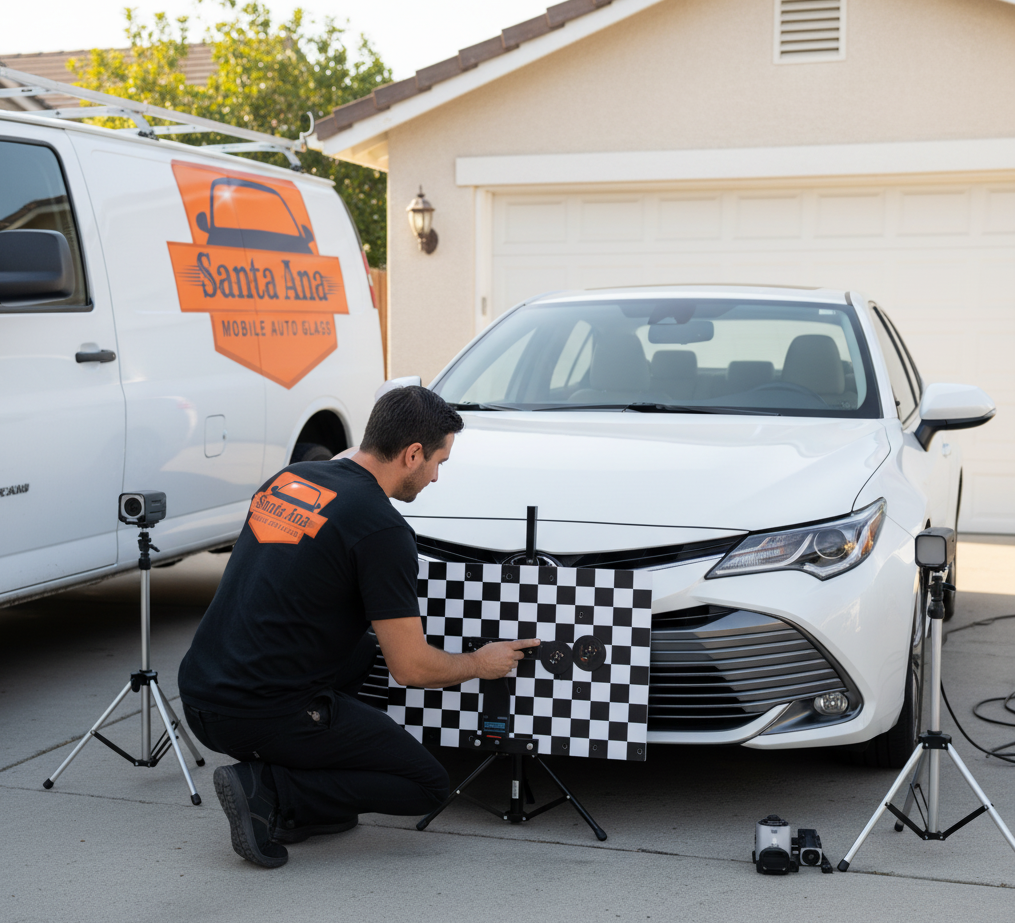
Performed with the vehicle stationary in a controlled setup. Manufacturer specified targets and precise measurements are used to align cameras and sensors to the correct reference.
Performed with the vehicle in motion when required by the manufacturer's procedure. The system completes learning and confirmation under defined conditions, then proceeds to diagnostic verification.
Vehicle year, make, model, trim, equipped ADAS package, the system being calibrated, and what repair occurred. Intake details decide scope and scheduling.
ADAS calibration is vehicle specific. Scheduling and pricing depend on procedure requirements and system scope.
Vehicles require ADAS calibration after windshield replacement when equipped with a forward facing camera or connected sensors. Calibration restores camera alignment and system accuracy. Intake inspection confirms if the vehicle requires calibration based on manufacturer procedures and installed ADAS features.
The main difference between static calibration and dynamic calibration is the calibration method. Static calibration uses fixed targets in a controlled environment to restore the reference. Dynamic calibration uses driving procedures to recalibrate systems in motion. Some vehicles require one method, while others require both.
ADAS calibration time ranges from 30 minutes to 2 hours, depending on vehicle configuration, system count, and calibration method. Static calibration, dynamic calibration, or combined procedures affect duration. Providing vehicle details and repair history ensures accurate scheduling and proper calibration workflow.
ADAS calibration cost depends on vehicle configuration, system scope, calibration method, and documentation requirements. Pricing increases with multiple systems and combined calibration procedures.
Contact Santa Ana Mobile Auto Glass now for ADAS Calibration Service.
Request a Quote